
Research project “The Monastery of Ayia Napa”
by Dr Max Ritter
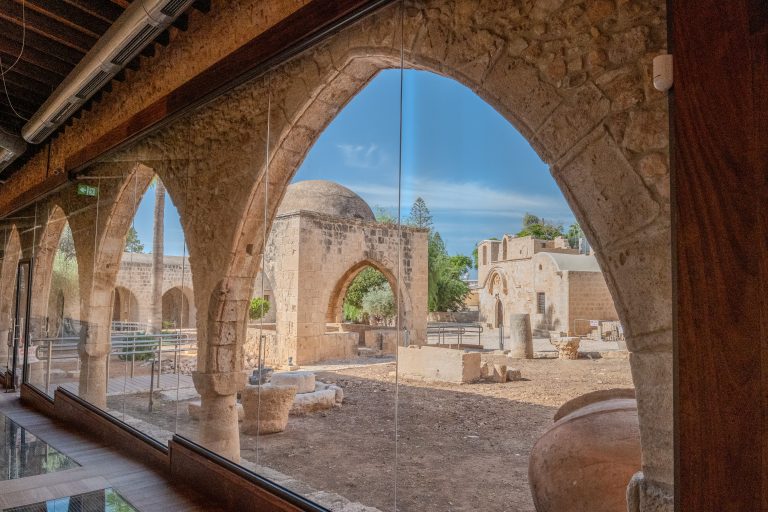
The Ayia Napa research project began in 2011 at Freie Universität Berlin as a practice-oriented initiative in teaching and research. Its aim was and remains to study the history, art history, and architecture of the Ayia Napa Monastery and to contribute to the development and creation of a museum within the monastic compound. In its heyday, the monastery housed a famous icon of the Ever-Virgin Mary and was an important place of worship within Cyprus and beyond, visited by both Orthodox and Catholic pilgrims. Our research focuses on the buildings of the complex, as well as written sources relating to the history of the monastery, in particular archival documents and travel accounts.
Building on our research findings, we seek to make this history tangible by highlighting and interpreting archaeological and local finds, as well as architectural elements of the monastery. These objects will form the core of an emerging museum within the monastic compound. The initiative also aims to provide educational benefits, expand learning opportunities, enrich the local community and attract visitors from across Cyprus. At the same time, it supports international research and teaching in Mediterranean history and culture.
Since its inception, the project has been under the aegis of the Holy Metropolis of Constantia and Ammochostos and the “Saint Epiphanios” Cultural Academy and has been carried out in cooperation with the Department of Antiquities of the Republic of Cyprus and the Ayia Napa Municipality of. The project is under the scientific responsibility of Freie Universität Berlin and Ca’ Foscari University of Venice.
Key aspects of the project include networking and collaboration with international scholars and local research institutions, as well as the production of academic publications. Over the course of the project, research results have been presented at conferences in Nicosia, Paralimni, and Münster, with some results already published.
Current research team:
Sven Brummack, Lorenzo Calvelli, Iosif Hajikyriakos, Theo Lerle, Dalila Meneen, Michael Nielsen, Max Ritter, Brigitta Schrade, Gaia Mia Trentin
Former members:
Damian Krikcziokat, Cleopatra Moschona, Guido Petras, Julia Pohlenz
Publications:
Schrade, B. (2024), “Sharing the Holiness: Agia Napa and the Byzantine-Latin Transfer of Hagiography and Iconography,” in C. Kakkoura and Chr. Christodoulou (eds), Πρακτικά Γ’ Συνεδρίου Κυπριακής Αγιολογίας, Ιστορικά και Θεολογικά Μελετήματα 4 (Ayia Napa – Paralimni, 2024), 657–716.
Trentin, M. G. and Vico Lopez, L., “The Case of Ayia Napa Monastery,” in S. Martinez-Rodriguez and G. Pace (eds), Practices for the Underground Built Heritage Valorisation: Second Underground4value Handbook (Rome, 2023), 33–42.
Trentin, M. G., Altaratz, D., Caine, M., Re’em, A., Tinazzo, A. and Gasanova, S., “Historic Graffiti as a Visual Medium for the Sustainable Development of the Underground Built Heritage,” Sustainability 15 (2023): 1–27.
Ritter, M., “Famagusta and its Environs in the Venetian Period: The Foundation of the Monastery of Ayia Napa and the Origin of its Fountain,” in M. G. Parani and M. Olympios (eds), The Art and Archaeology of Lusignan and Venetian Cyprus (1192–1571): Recent Research and New Discoveries (Turnhout, 2019), 125–144.
Petras, G. (2019), “A Stone Iconostasis in a Multi-Confessional Sanctuary in Lusignan and Venetian Cyprus? An Art-Historical Approach to the Cave Church in Agia Napa,” in M. G. Parani and M. Olympios (eds), The Art and Archaeology of Lusignan and Venetian Cyprus (1192–1571): Recent Research and New Discoveries (Turnhout, 2019), 145–165.
Ritter, M., “Cyprus and the Great Western Schism: A Re-Evaluation of the Obedience(s) of the Latin Church of Cyprus at the Time of the Great Western Schism (1378–1417) on the Basis of Documents in the camera apostolica in the Vatican Archives (ASV),” Επετηρίς Κέντρου Επιστημονικών Ερευνών Κύπρου 39 (2016/18): 217–255.
Calvelli, L., “Archaeology in the Service of the Dominante: Giovanni Matteo Bembo and the Antiquities of Cyprus,” in B. Arbel, E. Chayes and H. Hendrix (eds), Cyprus and the Renaissance, 1450–1650 (Turnhout, 2012), 19–66.